This is the third part in an ongoing series intended to explain the workings of LLMs. See the intro post for an overview and what I mean by “No Hype”.
So far, we’ve learned what a neural network is, how simple ones are designed, and how they’re trained. Right now when people talk about AI, they’re talking about neural networks that work with text: producing it, sometimes, but especially prompted by text. Systems where you can ask things like, “How many Rs are there in ‘strawberry’” or “Draw me a strawberry like one of your French girls” or “Write me a polka about strawberries.” Systems that are there for your strawberry needs, is what I’m saying, assuming you express those needs in text and don’t need to actually eat one. This post is going to explain how that’s done. Eventually. Sorry, this is a long one, long enough I split it into two parts, but I promise it’s worth it.
Words are Hard
Something in my last post might have bothered you: You know there are neural networks that work with text. You’ve seen them. You can’t avoid them. But I told you that neural networks need to work with numbers. Specifically, they need to work with measurements.
Age, height, pixel colors, even numberness1: all measurements.
Not every number is a measurement. Numbers are sometimes used just as labels. ZIP codes, phone numbers, tax IDs, that kind of thing. But we can turn labels into measurements, sometimes, with a little work.
Street addresses are kind of labels and kind of measurements; adding to or comparing house numbers can tell you something, if you know they’re on the same street, but otherwise they’re just labels. However, we were able to convert those labels into measurements. With some way of looking up the latitude, longitude, and altitude of street addresses, that gives us a coordinate space, like those graphs we drew in math class with x and y axes.
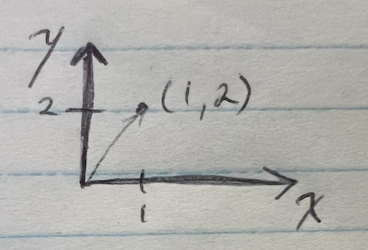
Coordinate spaces like those Cartesian coordinates have all kinds of meaning as measurements: I can compare them, I can see how far apart two addresses are, I can add 0.1 latitude and know that I’m looking at a point a bit north of that address. I can treat them as positions, or as directions (aka vectors) from some origin point. We know to be careful when talking about what a neural network actually does, because that stuff gets very alien very fast, but we know how neurons work, and coordinates ought to work better than address labels.
Text is hard, though. Words, letters, and characters are like labels, but they’re not just substituting for a single definable thing like a specific house2. Words can represent concepts, sounds, connotations, relationships.
What we want to do is to convert semantic similarity into some kind of geometric proximity: Two words being close to each other on some imagined map means they’re like each other in some important way. If we can manage that, then words can become enough like measurements that a neural network can work with them.
That “semantic similarity” concept can be slippery when you’re talking about words as things. Words don’t always label just one concept. Words change meaning according to their neighbors. ZIP codes don’t do that. ZIP codes don’t suddenly refer to different parts of the country depending on the ZIP code you read before it.
Take one word: moist. It has a dictionary definition. It’s a specific part of speech. It’s the name of a Terry Pratchett character. Some people find the word unpleasant. It rhymes with joist, for any would-be McGonagalls out there. The actual meaning of a particular instance of the word depends on what’s going on in the sentences and paragraphs around it. That just feels a lot harder to capture in a measurement than a street address, and it is going to be harder.
That said, we have some leads.
Memory Palaces
I have an absolutely terrible memory3. So, I’m fascinated by systems people have developed for improving memory, going at least as far back as the ancient Greeks. One of the techniques that keeps coming up, and which never works for me, is the memory palace.
The memory palace technique takes advantage of the human ability to remember visual and spatial information in special ways: our ancestors needed to remember where things were4. So, if we memorize things by mentally placing them in a familiar space, we can recall them by visualizing ourselves visiting that space. And we may arrange things within that space according to some kind of principle or rule that’s going to help us remember them.
This technique has never worked for me, so I’m probably getting details wrong, but the crux of it is that placing concepts in an imagined physical space lets you mentally arrange related things near each other and make use of spatial memory to recall things that would otherwise be difficult to remember.
Let’s say I’m planning Thanksgiving dinner and need to remember what order things go into the oven. I might imagine myself walking from the front door of my childhood home to the kitchen, encountering a turkey on the doorstep, potatoes piled up on our shoes, the couch covered with stuffing, etc.
The place and movements become intertwined with the concepts, but also how the concepts are arranged relative to each other. Moving along a path in this memory palace has meaning: it’s like reading off a sequence of instructions. But I can only really remember one semantic meaning (“order into the oven”) at a time this way: this won’t inherently help me remember what comes out of the oven first, though I might find a clever way to do it by another familiar path.
You can imagine using a memory palace to organize words. There are a lot of words, though, so some strategizing is in order. My memory palace house has rooms, and those rooms have their own layouts. Maybe I decide to put all my nouns in the living room. All my adjectives go in the dining room, and all the verbs in the kitchen. Nouns referring to people go onto a bookcase with several shelves. But how do I arrange them?
Maybe I split them up by profession or role. Cook, producer, president, waiter, actress, producer, actor, waitress, king, queen… Hmm. There are some sub-patterns. Waiter and waitress; actor and actress; king and queen. I could do some sub-arrangements here. Roles related to food go on one shelf, and pairs like waiter/waitress or host/hostess can be next to each other. Then another shelf for show business, and I can be consistent in having actor/actress together. Then another shelf for government with king/queen.
Oh, wait. Shoot. The words “king” and “queen” are kind of ambiguous. They’re also mattress sizes, right? And maybe in the adjective room I’ve already ordered words by size: “big”, “bigger”, “biggest” from left to right would contradict having “king” on the left and “queen” on the right. I could maybe put them both on the respective west wall of their rooms. But “twin” wouldn’t even be on the same shelf as “king” and “queen”, so I might able to find “twin” if my starting point was thinking about siblings, but not thinking about bedding. And how on earth would I find “queen” if I were starting from “mercury,” “may,” “bowie,” or “music”? And what if I start with “pawn” or “drag”? Argh!!
Laying things out in a house means making painful compromises even when words don’t represent multiple concepts. I’ve discarded landmarks at this point, but I can pick the room a word goes in, then north/south, east/west, and above or below. I’m working with four dimensions, essentially. Like street addresses, I can arrange and rearrange words and then convert those words into numbers. Maybe use inches from the north wall, inches from the west wall, and inches off the floor. Or imagine the room packed with numbered bookcases with numbered shelves like in that Borges short story about the infinite library. I can say, living room, west bookcase number 3, shelf 2, fifth book. Or shorthand: (1,4,3,2,5) just like my (x,y) coordinates if I continued past z and straight on til morning.
That’s all ridiculously complicated, but that shorthand is measurement-like. I could feed it into a neural network. It could add and compare. Distances would make sense, in that related concepts are closer together. My memory palace might be a hoarder house and Melville Dewey’s worst nightmare, but at least there’s a system, right?
Visualizing this as a physical space limits what I can do, though. Additions are a real cognitive stretch. When I subdivided the palace into rooms, you can kind of picture the concept “same place in a different room,” which essentially gets me to four dimensions. I can get to five if I have multiple memory palaces: The desert house’s laundry room is one conceptual step away from the beach house’s laundry room, and two steps away from the suburban house’s attic. I can still talk about the bookshelf on the west wall in each of those rooms. If I’m really clever and think through it very carefully, I feel I could do something with those five dimensions to capture at least a few relationships so that the coordinates mean something as a measurement, and in turn represent something more to the neural network than just a number: to recognize that “bartender” and “cook” are closer neighbors than “bartender” and “firefighter”.
But let’s be honest: I’m running out of steam, and the rent on all these memory palaces is getting ridiculous. I don’t have a principle for arranging things, and even with a lot of space I still need to make a lot of tradeoffs that I don’t know how to make. I’m on the right track to finding a measurement scheme that lets me organize things as complicated as words, but I need a different intuition to progress. Also, I’m getting hungry. Let’s all go find some place to eat.
Bistromathics
It’s tough to pick a restaurant for a group of any size. There are a lot of different things out there to eat, and we all like different foods. People read this blog from all over the world. But I’ve got a plan.
Let’s imagine for a moment that I’ve taken the time to make a huge long list of all the things it’s possible to order at a restaurant. Not a particular restaurant: any restaurant, anywhere. French fries, milkshakes, aloo gobi, tacos, haggis, bao, mofongo, borscht, omelet rice, soup dumplings, beer. Anything. Everything. I’m just going to make a big long list of foods.
I’ll take that list and put checkmarks next to each food, and for each restaurant we’ll make a copy of the whole list and represent its menu by which things are checked off. Now I can show you a list where the checkmarked entries are something like: hamburger, cheeseburger, bacon cheeseburger, hot dog, French fries, milkshake, Coca-Cola, peanuts.
What restaurant is this?
You might say, “That sounds like a burger joint.” Or even, “I think that’s Five Guys.”
Why isn’t it a McDonalds? Well, you might point out, there are no chicken items on there: no nuggets, no sandwiches. And McD’s doesn’t serve peanuts. But it’s otherwise pretty close, right? In fact, if you’re up on your American-style fast food, I bet you can put together a bunch of similar lists. While you might not be able to tell whether you’re looking at the menu for a McDonalds or Burger King without the names “Big Mac” or “Whopper” I bet you’d be close, conceptually. Maybe off on Coke vs Pepsi, but you’d be in the right neighborhood.
There’ll be a similar neighborhood for, say, American-style Indian restaurants5. Chicken tikka masala, butter chicken, naan, lamb korma. Hundreds of restaurants have menus close to that, but there will be subtle differences between Indian restaurants in the US and Indian restaurants in Brazil or Germany. Even so, those are going to be noticeably set apart from the menus for any American-style burger joint, even one in Mumbai.
But what might be on the menu of a Mumbai McDonalds? According to their website, there are chicken and fish sandwiches, chicken nuggets, and French fries. A lot of the breakfast items look the same. But beef burgers are off the menu, and there are additions like paneer burgers, and burgers with a patty like samosa filling6. Conceptually, you’d look at that menu and there’s a ton in common with other American-style burger joints, but it’s different, kind of away. If I said, “it’s away in the direction of an Indian restaurant” that kind of makes sense, right?
Did you notice the language I’ve been using? Words like “neighborhood” and “apart”? I’m using the language of position and direction even though we’re not in recognizable physical space. This is that memory palace instinct, our natural affinity to understand even abstract things in terms of location or proximity. This menu is “close to” another. This one is “in the direction of” another cuisine.
Remember that scene in the beginning of Pulp Fiction with Jules and Vincent talking about French McDonalds? It’s the little differences, right? They were mostly talking about names, but you can get a beer at a Paris McDonalds. Vincent didn’t go to a Burger King, but if Jules had to guess what was different about a French Burger King menu (other than the metric system) he’d probably guess: it’s like an American Burger King except you could order beer there. He’d draw an analogy from the Paris McDonalds.
In fact, you could do this trick more generally. Take a McDonalds in Egypt and match up its menu against the American McDonalds. If there’s anything new (some Sprite mixed sodas, a chocolate cake), mark that +1. If there’s anything missing (no bacon cheeseburgers, it looks like), mark that -1. Anything that’s the same (either both have it, or neither have it), ignore.
Now you’ve got a list of things to add and subtract, and if someone asks you what a Cairo Wendy’s might sell, you can take your list and use it to modify an American Wendy’s menu. Will you be right? No; there are no Wendy’s restaurants in Cairo. But the concept “Cairo Wendy’s” still makes intuitive sense, and we used very high-dimensional vector math to get there.
The concepts of “American McDonalds” and “Egyptian McDonalds” are expressed as a very long series of checkmarks. The vast majority of possible foods are unchecked, because neither one sells okonomiyaki, caviar, clam chowder, etc. But you can go item by item (even without knowing what the items are), take the difference and have a special kind of menu: a difference vector.
This kind of menu math is how neural networks manipulate language. We’ve created a huge space with hundreds of dimensions, and moving around in that space makes sense.
It’s also a huge empty space. Picking random menu items is going to land you somewhere very far from any restaurants that actually exist. Navigating this space works best if you start somewhere known and move in intelligible directions even into empty space. This is a kind of dining shallows: the set of non-existent but plausible or understandable restaurants.
We can move by adding menus together. “Sort of like if KFC also did conveyor belt sushi7.” Or break it down, describing a single restaurant as a combination of smaller restaurants: “a Brazilian steakhouse has a barbecue menu, plus a salad bar; add that salad bar to a lobster shack and throw in Korean corn dogs”. Addition and subtraction make sense.
Multiplication of vectors is harder to analogize; instead we can quantify a kind of intuitive distance between two menus by totaling up how many menu items differ between the two8. I can whip up a menu from scratch based on what we all together want to eat, and then we have this distance concept to help us figure out which restaurants are sort of what we’re looking for. This lets us go from an imagined restaurant to a close-enough real one. We can get way weird, but still comprehend what’s going on, and still find our way to the “nearest” restaurant that’s the closest thing to whatever banana peel-smoking fever dream diner we wound up with. Nearest conceptually, that is, not driving time: we’ve completely discarded where even the real restaurants are in physical space.
Let’s take a step back. Mathematically this restaurant space is not that different from my memory palace, except that there are so many dimensions that they’re all very specialized, and the dimensions now have inherent meaning related to the concepts I’m trying to map out. (Oh man, there’s a beer dimension. And a French fry dimension9.)
I can take that restaurant space idea, with its concepts of neighborhoods and analogies, and I can apply the basic approach to the problem of words.
I quickly get into trouble, though, if I try to do this by hand. Sure, I can get a start. I can call one dimension nounishness (check here if this is a noun), and another adverbosity or adjectivitude. Then there’s some kind of gender, to take care of the waiter/waitress, actor/actress, king/queen thing, but a lot of words won’t have gender, because what is this, French? Oh, but we import French words, so we’ll need a Frenchishness dimension, and yeah I can start turning words like “croissant” into menus or recipes that take a little nounishness and a little Frenchishness and some fooditude and… yeah, I’m already in trouble.
I’m going to wind up with thousands of dimensions, most of which will go unused for the vast majority of words, just like very few restaurants will have “haggis” on the menu, even though wow is it significant when haggis does show up.
The good news is that we don’t have to do this by hand. In fact, we shouldn’t.
Instead, we can train a neural network to learn where words are in some high-dimensional latent space10. What space? Heck, I don’t know. We’ll train a neural network to pick where each word goes in some space, call those coordinates an “embedding” and make that embedding the input to the rest of the neural network. We won’t have to know how it works, because we’ll never touch it: kind of the same attitude my parents took toward my room as a kid. As long as you can find things in this mess, little network, vaya con Dios.
Conceptually, it’s no different from taking a street address and giving a neural network latitude, longitude, and altitude. It’s just preprocessing. Except, instead of three dimensions, we can just pick a number of dimensions that seems like a lot. And instead of having some kind of map that we look up addresses in, we’ll make a neural network learn the map for itself.
Maybe not just “a” neural network. We’d better unpack that one a bit. And where do we get labeled data to train it? For that matter, what kind of data would even work? How the heck do we pick an error function?
The Stochastic Parrot is a Jubjub Bird
“Beware the Jabberwock, my son!
The jaws that bite, the claws that catch!
Beware the Jubjub bird, and shun
The frumious Bandersnatch!”“It seems very pretty,” [Alice] said when she had finished it, “but it’s rather hard to understand!” (You see she didn’t like to confess, even to herself, that she couldn’t make it out at all.) “Somehow it seems to fill my head with ideas—only I don’t exactly know what they are! However, somebody killed something: that’s clear, at any rate.”
Lewis Carroll, Through the Looking-Glass and What Alice Found There
Let’s step back a minute and think about what exactly we’re trying to capture here when we try to encode words for a computer. Are we trying to capture a human-like understanding of these words?
No. It’s just too circular: we’d need to teach the computer the meaning of words in order to encode them, but we can’t teach the computer the meaning of words until we have that encoding.
So, let’s forget about trying to capture surtext11—what Humpty Dumpty chooses a word to mean when he uses it12—or even explicit dimensions like nounishness or Frenchishness. Those are just too tied to meaning. Subtext is right out. Instead, let’s mimic how kids are taught to recognize unfamiliar or nonsense words in a text: look at its context.
I will never understand exactly what was in Lewis Carroll’s head when he came up with “Jubjub bird” or “vorpal sword”. But I can look at the rest of the phrase, “Beware the (something) bird” and kind of understand that whatever the word “Jubjub” is, it’s a kind of bird; it’s a modifier. It could be a name like “Big” or an adjective like, um, “big”. Context doesn’t require us to understand a word, just to be able to recognize words and count them.
Context in words is closely tied to meaning, and for the moment I want to take a further step back to avoid confusion. Let’s return to that giant list of all the foods served in all the restaurants of the world. We’ve learned something about how restaurants compare to each other, and we can navigate an infinite sea of imagined takeout13. But really, we know nothing about the foods themselves; they’re just lists of checkmarks.
Let’s focus on the foods themselves, now: how can do for foods what we did for restaurants?
Restaurants, in this analogy, are a bit like a whole document or concept. Both are complex, but they’re expressed in smaller parts that themselves carry meaning. Foods, together in a meal, express a food culture that helps you understand the restaurant. Words, used together, convey concepts.
Let’s say that I have a list of meals. Those food order receipts we leave on tables or tuck in our wallets: grab them all up, everywhere all over the world. The same foods are served in many places and appear on many orders. No one order tells me as much as the whole menu might, but I can make up for that lack of information by sheer volume. There might be tens of thousands of restaurants, but there are billions of orders.
A meal order is a bit like a sentence. Whether we’re taking an order off a menu, or selecting words for a sentence, just a few items are chosen according to certain needed roles. Where a sentence might have nouns, verbs, adjectives, etc. a meal order might have appetizers, drinks, entrees, sides, desserts.
Now, there are still way too many foods to go through manually and categorize them; anyway, I wouldn’t recognize most of them. But I can deduce something role-like from sheer bloody statistics.
I’m going to set up a big damn spreadsheet with one row and one column for every food I know about: a giant square. Then I’m going to go through every single order and just count pairs: this person ordered a hot dog, French fries, ketchup, mustard, and a Coke.
OK. Find the row for hot dogs, and then the column for everything else in the order and add one. One for hot dogs14, and one for French fries, and one for Coke, ketchup, mustard, etc. Then go to the row for French fries and add one in the hot dog column, the French fries column, the Coke column, etc. Then to the Coke row! You get the picture.
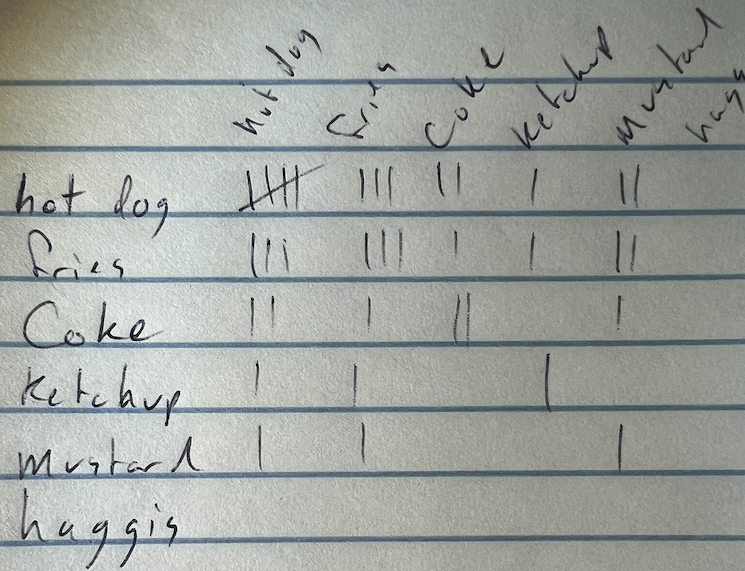
Now let’s say I’ve done this for every food in every order at every restaurant. My spreadsheet is stupidly big, but it kind of does what I want, right? It tells me, for each food, the company it keeps. Perhaps Brillat-Savarin15 was onto something: Tell me what is eaten with you, and I’ll tell you what you are.
Let’s take the rows for Coca-Cola and Pepsi. I haven’t actually built out this spreadsheet, on account of not having a list of all the orders from all the restaurants in the world, but I have a sense that the rows for Coke and Pepsi are going to look really similar. For every chain restaurant that serves one, there’s probably another chain with an otherwise-identical menu serving the other. They’re pretty much interchangeable16 but because restaurants generally serve only one or the other, orders will very rarely have both.
What do we think we know about Coke and Pepsi from these database rows? A list of orders says nothing of how they taste, but we know the company they keep: they appear in a wide variety of orders that otherwise probably look a lot alike, but they almost never appear together. They play the same role, like synonyms. Probably very similar rows will correspond to things like bottled water, orange juice, beer, Fanta.
It would be just as accurate, though, to describe them as “antonyms.” Again, meaning doesn’t enter into this process, only role. Grammatically, I can nearly always swap “big” and “small” the same way I can swap “Coke” and “Pepsi”.
These spreadsheet rows form a kind of super-fingerprint for each food. Each row will be distinct in a way that I can use as a label. Fine, I got that just from numbering them. But it also tells me something about that food in the way of my memory palace or high-dimensional restaurant space. I know nothing about what any of these foods tastes or smells like. But I know enough about the role any given food plays in a meal order that not only can I use it as input to a neural network, I can use it for output, too.
In the handwriting recognition example, we had an output neuron for every possible result, and if the neural network determined that a particular image had a strong aura of nineishness, the neuron associated with the number 9 output would activate the most strongly. But instead of having a dedicated output neuron for each kind of food and picking whichever one has the strongest activation, I can treat the output as the fingerprint I want.
If my neural network chugs through some kind of input and says, “hey, your output is some kind of food that goes with a hot dog, fries, ketchup, and mustard” then we can look around the neighborhood of that meal vector and pick as the nearest neighbor something like Coke, Pepsi, Fanta, etc. If I move away from “hot dog” and toward “haggis” the nearest neighbor to the spot I land on might be Irn Bru. I’ve got a junk food sommelier!
And! If my inputs and outputs are these fingerprints, then I have a way of handling new things without retraining the whole network. If some restaurant somewhere starts serving Jubjub nuggets, then I only need to see enough order slips to get a sense of how it fits into this embedding space, and my network can handle it as either an input or an output just fine. I can now deal with new things, even with nonsense.
There is still a weakness here: I’m going to wind up with thousands of foods, and when I try to translate this concept into words, it’s going to just explode. Plus, most of these are going to go unused the vast majority of the time, just like very few order slips will contain “haggis”, even though wow is it meaningful when it does show up.
What if I tinkered with the dimensions to cut them down a bit? Fish and chips go together, right? Conversely, things like set orders in sushi restaurants17 can be broken down into their a la carte components that we’ll need to have anyway, so I can ditch menu items “Regular sushi” or “Deluxe sushi”. Or get complicated: Coca-Cola and its competitors duplicate so many sodas, why not switch to “Coke product”, “Pepsi product”, etc. and add “cola”, “lemon-lime” and “diet” dimensions? I’ll lose some accuracy in combining things if not literally everyone ordering buffalo wings also gets blue cheese (monsters!), but I’ll get to compact this a lot and in turn really shrink my neural network.
This process of dimension reduction has a lot of benefits, but it’s difficult and the individual dimensions become hard to understand. We can still move around and do analogies in this reduced space, but we probably won’t understand as naturally where we are or how we got there until we look around at the nearest foods and try to make sense of what they have in common.
Still, I think we’re on the right track here as we pull back from this food analogy and look at words again. However many foods there are, there are a ton more words, and more all the time. Embeddings let us deal with new words being invented all the time—Lewis Carroll will not defeat us!—but we’re still not working with meaning. We know about words, like foods, by the company they keep, and we can know that in very great detail.
Now just to figure out how to make a computer actually do it.
Placeholder for Part II of this post
- If you looked here for a definition of “numberness” you didn’t read the previous post. Go read the previous post, or better yet start from the intro. This post will make a whole lot more sense if you do. I’ll wait. ↩︎
- Even the actual name of a house, like “10 Downing Street” means more than one thing when treated as text instead of more mechanically as an address. ↩︎
- It’s what makes me so easy to get along with. ↩︎
- They didn’t wear eyeglasses or carry car keys, so losing those doesn’t count as shaming my ancestors. ↩︎
- Not Bindhi Bros, though. I’m not going through that again. ↩︎
- I wasn’t actually hungry until I started this paragraph, but scrolling the McIndia site made me break for dinner. ↩︎
- This is mathematically distinct from conveyor belt fried chicken, but isn’t that an awesome idea? ↩︎
- Essentially this method of determining the distance between two vectors is what’s called Manhattan distance or taxicab distance, where your Manhattan taxi has to either go north/south or east/west along the grid roads or risk very heavy fines. Actual distance metrics are going to be a bit more involved than this to get a better sense of what people think of as “distance”; there’s a method called “cosine similarity” in particular that’s important to LLMs.
Cosine similarity boils down to: if I stand in a special place and point at one location, how much do I have to move my hand to point at another location? The smaller the angle my hand has to move, the more similar the two points are, regardless of how far away they are. The cosine similarity of the sun and moon, for example, might on a given day be the same as the cosine similarity of the moon and Alpha Centauri even though Alpha Centauri is lightyears further away. ↩︎ - My ancestors are basically Irish, French Canadian, and Yankee dirt farmers. French fries are my only ethnic food. ↩︎
- A latent space is one built up like this by machine, learned from its training examples for the purposes of encoding information. We just don’t know what the dimensions of a latent space mean, if anything, and that makes these spaces (useful as they are) impediments to understanding what’s going on in them. People debate whether this space is entirely an invention of the network for its own workspace, or whether this is more along the lines of exploration and discovery of some hidden real phenomenon. The menu space, by contrast, enormous and weird as it is, was still explicitly built up in an understandable way with each dimension tied to a specific concept. ↩︎
- “When I use a word,’ Humpty Dumpty said in rather a scornful tone, ‘it means just what I choose it to mean — neither more nor less.’
If subtext is the hidden meaning “underneath” what’s said, then surtext is the intended, up-front, sometimes blatant meaning right on top. ↩︎ - I had to stop myself from reprinting huge swathes of Lewis Carroll’s work, but it’s well worth a reread. He was fascinated by a number of linguistic topics that turn out to be even more interesting from the perspective of machine learning. ↩︎
- Eat your heart out, Borges. ↩︎
- It’s good to track how often things are ordered, because that tells us something about what we can know about a thing: if a thing just doesn’t get ordered that often, we might not have enough information about it to draw any conclusions. Conversely if it shows up all the time (like, say, tap water, which some people order even alongside other drinks) it might likewise be tough to say what role it plays in a meal. ↩︎
- I do miss Iron Chef, but it would have made an absolute disaster out of these analogies. ↩︎
- I know, those are fighting words. ↩︎
- If we were still thinking at the level of restaurants we could compress even further thanks to set menus repeated across restaurants. The Global Thai project alone would make for a huge dimension reduction. ↩︎

